Houdini's Copy to Points, native in Nuke — for both 3D systems.
CopyToPoints (USD/Classic)
First submitted: 25 August 2026
Author: Marty Blumen
Website: https://www.martyblumen.com/
Compatible Nuke versions: 14.0 or later
Compatibility: Source
CopyToPoints
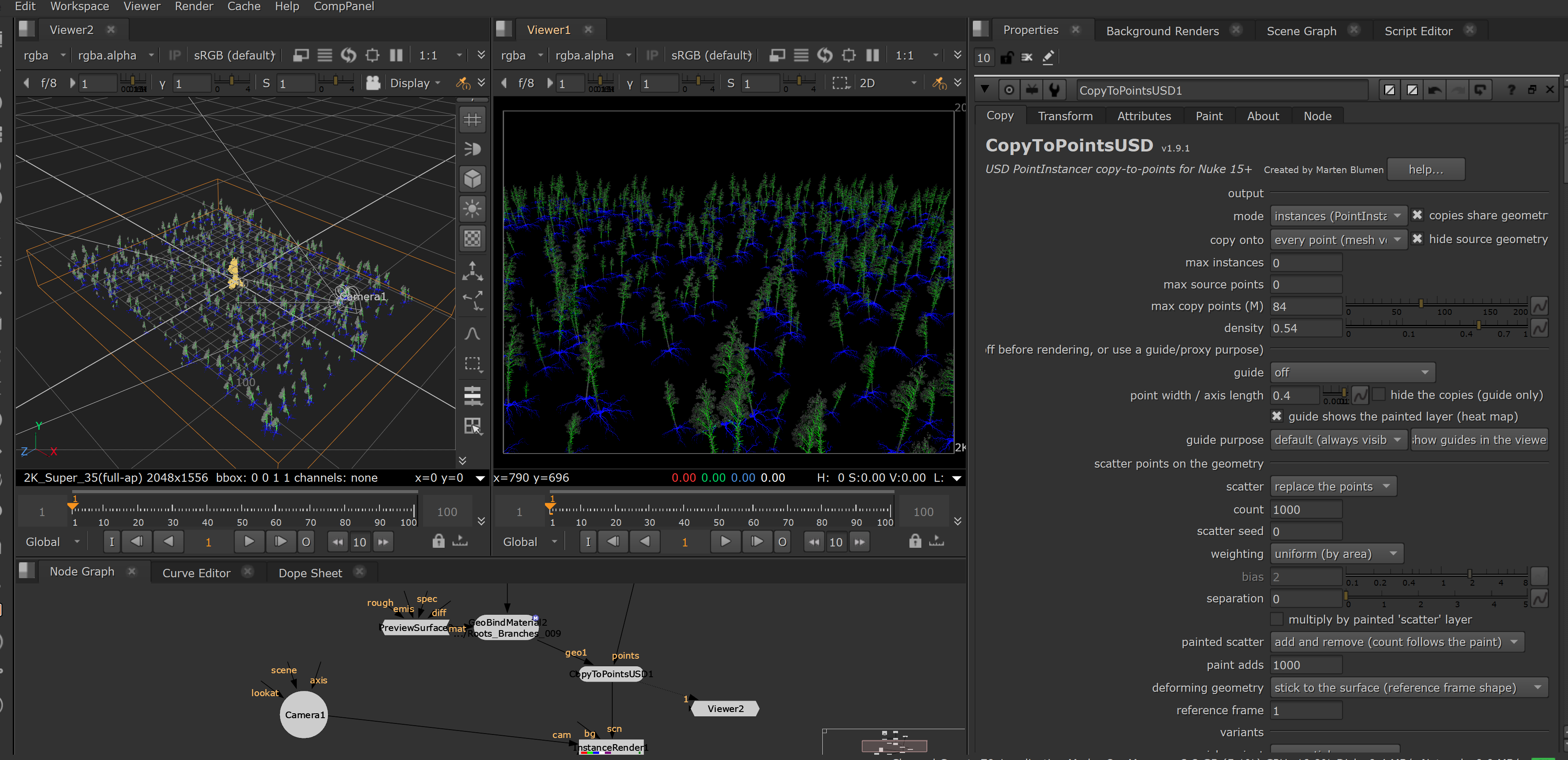
Houdini's Copy to Points, native in Nuke for both Classic 3D and USD.
Version 1.10.1 — Nuke 14.1–17.1 — Windows 64-bit — MIT
CopyToPoints provides five NDK plugins for instancing geometry onto points, scattering geometry across surfaces, painting placement in the 3D viewer, and bridging Nuke's particle and volume systems into USD.
Highlights
Instance or bake geometry onto point clouds.
Up to 32 prototype variants with sequential, random or attribute-based selection.
Particle-aware velocity, orientation, rotation, age, scale and collision attributes.
Align copies to velocity, quaternion, Euler or particle orientation.
Surface scattering with area weighting, slope/height bias and deterministic Poisson-style separation.
Deforming-surface scattering with stable point placement.
Interactive 3D painting for density, scale, rotation, variant, scatter and colour.
Per-copy random rotation, scale, offset, density and colour, keyed by particle ID for temporal stability.
Guide geometry for inspecting placement, orientation and scale.
Shared instances keep memory largely independent of prototype complexity; bake mode creates real geometry for export and downstream nodes.
Pixel-identical renders between instance and baked modes.
Nodes
CopyToPoints — Classic 3D GeoOp for point instancing, scattering and painting.
MultiplyCf — Applies per-copy geometry colour for Classic 3D rendering.
CopyToPointsUSD — USD GeomOp producing UsdGeomPointInstancer or individual prototype references.
ParticlesToUSD — Converts Nuke particles to USD points, including velocity, colour, IDs and channels.
VolumeToUSD — Converts Nuke VDB volumes to USD Volume prims with density and emissive grids.
The USD nodes bridge gaps between Nuke's Classic 3D particle/volume systems and the USD scene graph.
Performance & Safety
Built-in limits prevent accidental scenes from taking down Nuke. Classic 3D defaults to 250k source points; USD defaults to 20M copy-points (copies × prototype points).
High copy counts can still become expensive when rendered through ScanlineRender2, which may un-instance geometry. Use proxy geometry or reduce copy counts for heavy prototypes.
Compatibility
Nuke 14.1v8, 15.2v9, 16.0v8, 16.1v1, 17.0v4 and 17.1v1, Windows 64-bit.
Installation
Run the included install.bat or install.ps1, restart Nuke, and find the nodes under 3D > Modify and 3D > Shader.
An example script is included at examples/CopyToPoints_example.nk.
See also: InstanceRender, the companion renderer designed to keep USD point instancing intact through the acceleration structure.
Opensource
MIT License
Copyright (c) 2026 Marten Blumen
Permission is hereby granted, free of charge, to any person obtaining a copy
of this software and associated documentation files (the "Software"), to deal
in the Software without restriction, including without limitation the rights
to use, copy, modify, merge, publish, distribute, sublicense, and/or sell
copies of the Software, and to permit persons to whom the Software is
furnished to do so, subject to the following conditions:
The above copyright notice and this permission notice shall be included in all
copies or substantial portions of the Software.
THE SOFTWARE IS PROVIDED "AS IS", WITHOUT WARRANTY OF ANY KIND, EXPRESS OR
IMPLIED, INCLUDING BUT NOT LIMITED TO THE WARRANTIES OF MERCHANTABILITY,
FITNESS FOR A PARTICULAR PURPOSE AND NONINFRINGEMENT. IN NO EVENT SHALL THE
AUTHORS OR COPYRIGHT HOLDERS BE LIABLE FOR ANY CLAIM, DAMAGES OR OTHER
LIABILITY, WHETHER IN AN ACTION OF CONTRACT, TORT OR OTHERWISE, ARISING FROM,
OUT OF OR IN CONNECTION WITH THE SOFTWARE OR THE USE OR OTHER DEALINGS IN THE
SOFTWARE.
or register to download or rate.
Comments